
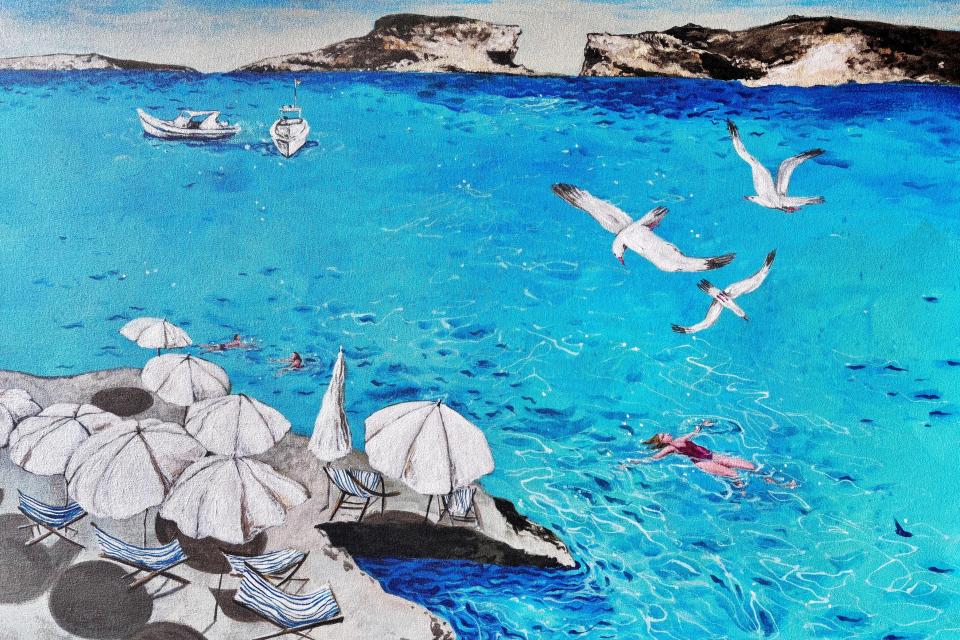
“From South Africa to Malta” reads like a visual diary that traces routes, ruptures, and reclamations across continents, using memory as both compass and archive. The journey begins with an act of location: placing a country of origin on a map and asking “Where is my country? Where can I locate it?”, a small but profound gesture of appropriating space and naming belonging. From there, memory cartographies unfold as drawings, icons, and fragments that mark cities passed through, towns settled in, and the ordinary textures of daily life that migrants carry with them. These visual records do not aim for completeness; they assemble routes and locations into personal atlases where identities are negotiated between places left and places newly inhabited.
The move from South Africa toward Malta is not a straight line but a scattering of histories. Queerness, migrancy, and the question of the archive intersect in ways that resist neat chronology, because diasporic life is often lived through “uneven traces of dispersal and scattering”. Oral histories, personal photo albums, and salvaged objects become the material of remembrance. A photo album can function as a queer migrant archive, an assemblage that memorializes quotidian acts of fugitivity and refusal, curating a life against invisibility. Likewise, individual objects — a passport, a piece of clothing, a family snapshot — operate as fragments of an open-ended narrative. Photographer Mario Badagliacca’s work _Fragments_ shows how items retrieved from migrants on Mediterranean routes reveal expectations, fears, and endurance, yet cannot tell a full story until imagination frames them.
In this visual diary, memory is not static. It is performed through practices of remembrance that link territories and communities, configuring senses of belonging that shift with each border crossed. For asylum seekers and refugees from sub-Saharan Africa arriving in Europe, memory, language, food, belief, and hope become key anchors for sustaining personal identity amid trauma and forced relocation. The journey from South Africa to Malta, whether literal or conceptual, also passes through places like Kenya, Cairo, Tripoli, and the sea itself, each leg inscribed with risk and agency.
Contemporary artists and researchers respond to these movements by rejecting hierarchies of knowledge and classification. Archives of migration struggles now propose models that foster encounters among diverse experiences, memories, bodies, and objects, using drawings and multimedia diaries as knowledge-making tools that interweave varied migration experiences. The Diari Multimediali Migranti project, for instance, collects testimonies that document motivations, travel, reception, integration, work, and relationships, treating the migrant’s voice as source and method.
Ultimately, a visual diary from South Africa to Malta is less about documenting a single trajectory than about holding space for multiplicity. It acknowledges that the past life of émigrés is not annulled but transposed onto screens, paper, and fabric through gestures of re-membering, touch, and journeying. Each image, map, or scrap becomes part of a collective memory that works to conserve history, culture, and identity across diaspora, offering solidarity and survival in the fractured history of migration.