
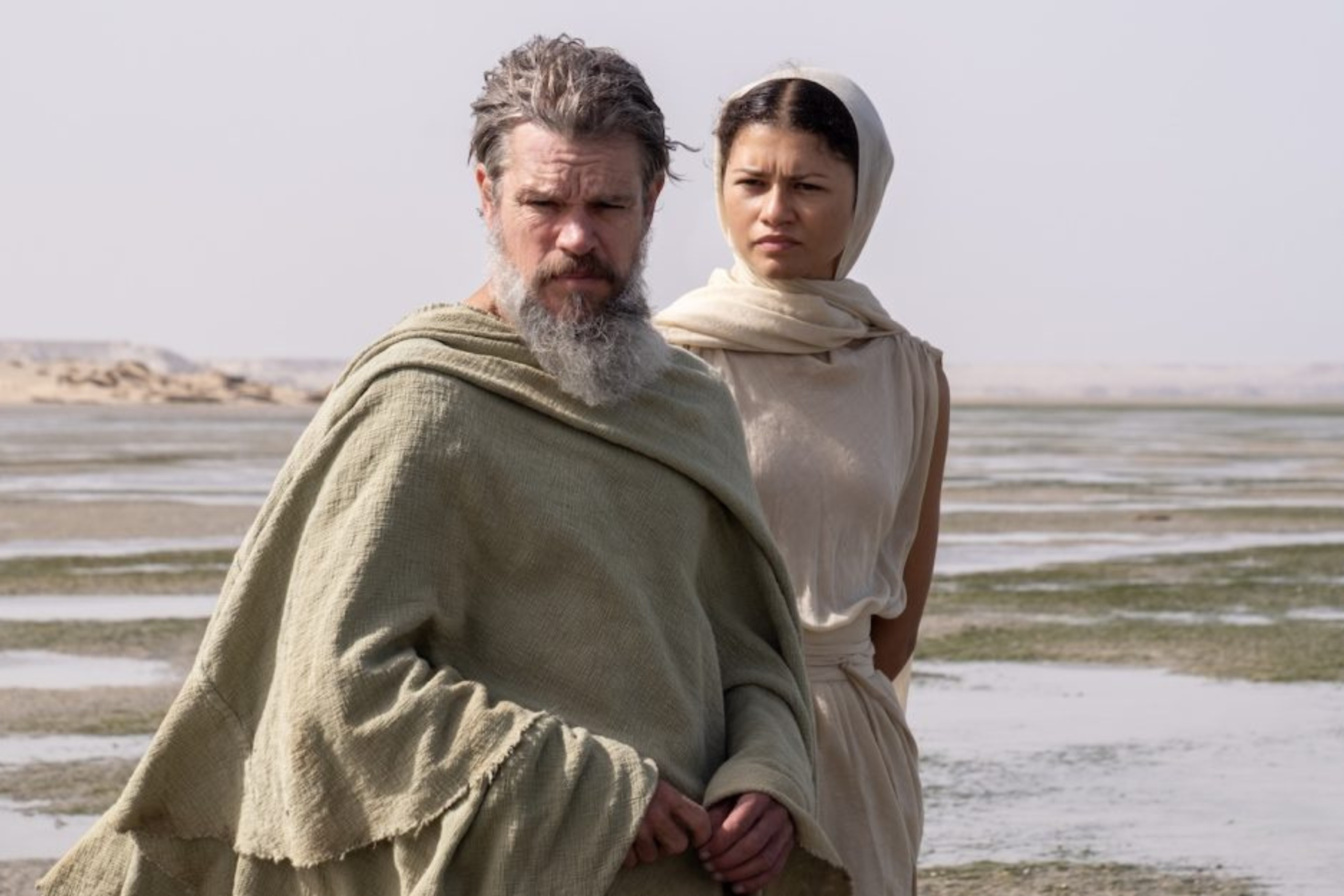
Christopher Nolan’s upcoming adaptation of Homer’s _The Odyssey_ has become a lightning rod for culture war debates months before its July 17, 2026 release, with criticism spanning casting choices, historical accuracy, and the film’s shooting locations. The controversy ignited after reports confirmed that Lupita Nyong’o, who is of Kenyan descent, would play Helen of Troy, the woman whose beauty sparked the Trojan War. Critics argued Nyong’o was not sufficiently beautiful for the role or claimed Nolan was placating Hollywood’s “woke” diversity regime to satisfy the Academy’s Representation and Inclusion Standards, which took effect in 2024. Commentator Matt Walsh said Nolan knows he would be called racist if he gave “the most beautiful woman” role to a white woman, while Elon Musk suggested Nolan was chasing awards. The casting backlash also included false rumors that Elliot Page would play Achilles. Supporters countered that Nyong’o is an Oscar winner and “undeniably gorgeous,” and argued that the outrage reflects a broader “negativity economy” where online exploiters of resentment make films like _The Odyssey_ the punching bag of the season.
Beyond casting, the film drew fire for its approach to material culture and language. Detractors cited “the Americanization of The Odyssey’s dialogue, the possible dependence on a tendentious feminist source translation, a ludicrous stance on material culture, and inappropriate casting”. The first trailer amplified complaints about “historically inaccurate” armor and costumes, including Benny Safdie’s Agamemnon in matte black armor some dubbed “Greek Batman,” and American accents with modern words like “daddy”. Defenders noted that _The Odyssey_ is mythology, not history, and is fictional with cyclopes and other mythological elements. _SlashFilm_ argued it is “hard to wrap one’s mind around the fact that _Christopher Nolan_… is now a lightning rod for largely American culture-war nonsense” and stressed that viewers should “actually _watching_ a movie first before disowning it”.
A separate geopolitical controversy erupted over filming locations. Nolan spent four days shooting near Dakhla, a city in Western Sahara, a territory 70% occupied by Morocco and classified by the United Nations as “non-self-governing”. The Western Sahara International Film Festival (FiSahara) issued a public appeal urging Nolan to halt production, stating “Dakhla is not just a beautiful place with cinematic sand dunes. First and foremost, it is an occupied and militarised city whose Indigenous Sahrawi population is subjected to brutal repression”. FiSahara’s executive director María Carrión said that by filming in a “news black hole,” Nolan and his team are “contributing to the repression of the Sahrawi people by Morocco, and to the Moroccan regime’s efforts to normalise its occupation”. The Polisario Front accused the production of “whitewashing colonialism” and “a clear violation of international law and ethical standards”. Actor Javier Bardem amplified FiSahara’s message on social media. Universal Pictures and Nolan have not publicly responded to the criticism.
Despite the backlash, Nolan’s _The Odyssey_ remains one of 2026’s most anticipated films, starring Matt Damon as Odysseus alongside Tom Holland, Anne Hathaway, Zendaya, and Charlize Theron. The film adapts Homer’s epic poem and was shot in multiple global locations including Greece, Italy, other parts of Morocco, and Dakhla. Commentators have noted that much of the discourse treats speculation as fact and judges the film without context, reflecting a broader trend where “balanced criticism doesn’t get clicks anymore, but outrage does”. _Den of Geek_ argued the debate reveals a “surface level understanding of Homer online” and that online grifters have made _The Odyssey_ the punching bag of the season.