
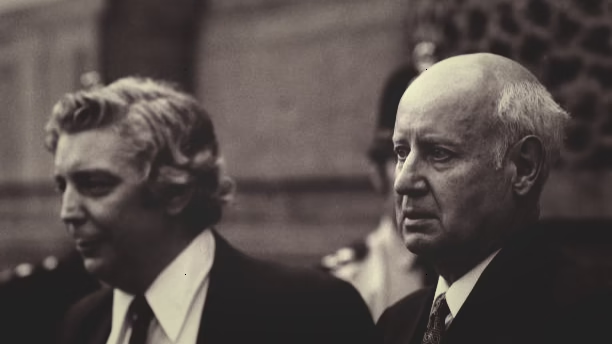
When you think of British politics, you might picture stiff upper lips, carefully worded speeches, and perhaps the occasional parliamentary scandal splashed across the magazine. But in the 1970s, a web of corruption unraveled so deep, so brazen, that it could easily pass for the plot of a crime thriller.
Who Was John Poulson And Why Was He So Dangerous?
John Poulson wasn’t a politician and that’s exactly what made him so effective. He was a well-connected architect who built not only concrete buildings but a network of influence stretching across town halls, Parliament, and even foreign governments.
Rather than compete for public contracts the traditional way, Poulson simply paid the gatekeepers . local councillors, MPs, civil servants +and in return, his firm won redevelopment projects across the UK and overseas. His “consultancy fees” were thinly veiled bribes that greased the wheels of bureaucracy.
He treated corruption like a business model. And for a while, it worked spectacularly.
The Political Earthquake in British History
Poulson’s financial empire came crashing down in the early 1970s under massive debt. What followed was a thorough investigation that uncovered one of the UK’s biggest corruption scandals — and it reached into the Cabinet itself.
At the center was Reginald Maudling, the Home Secretary and once a frontrunner to become Prime Minister. He had personal and financial linksto Poulson, having used his influence to broker deals overseas.

When those ties were exposed, Maudling resigned in disgrace in 1972, marking one of the most dramatic downfalls in modern British politics.
Other politicians and civil servants were caught in the net. Several were prosecuted. Poulson was eventually convicted of corruption and sentenced to seven years in prison in 1974.
A System Built on Shadows
The real shock wasn’t just Poulson’s bribes — it was how deeply normalized the corruption had become. Public officials accepted lavish gifts and money not because they were coerced, but because that was the system. Influence was for sale, and public money was being diverted to serve private interests
Had this happened in today’s world, the OCCRP would’ve followed the money trail across continents — exposing shell companies, offshore accounts, and secret deals.
Instead, it took brave journalists, whistleblowers, and a collapsing business to bring the scandal to light.
Evidence & Sources
-
The British General Election of 1970 by David Butler & Michael Pinto-Duschinsky — standard academic study of that election.
-
Biography and data on Edward Heath’s premiership, Labour’s economic challenges, public opinion polls.
-
History of British media ownership (e.g. Rupert Murdoch’s moves) around that time. Wikipedia
The Legacy of John Paulson
The John Poulson scandal remains the largest corruption case in British political history. It showed that even in countries with long-standing democratic institutions, corruption can thrive not in back alleys, but in well-furnished boardrooms and political offices.
It also forced reforms. The scandal prompted greater scrutiny of political lobbying, transparency in public contracts, and checks on the relationship between business and British government issues that are still relevant today.
| Entity / Individual | Role | Means of Influence (Media / Finance / Legislation / Other) | Known Evidence | Significance |
|---|---|---|---|---|
| Edward Heath (Conservative Party) | Leader of the Conservatives; became PM in 1970 | Political campaign funding, party organization, manifesto promises | Conservative party machinery, public expectations vs Labour record | Heath’s victory was partly due to public dissatisfaction plus economic concerns under Labour. |
| Harold Wilson (Labour Party) | Incumbent Prime Minister, lost 1970 election | Record of government policies, public sector investment, social reforms | Reforms in labour laws, social policy changes | Wilson’s government was viewed as having done much in social reform; but economy and inflation were concerns. |
| Media (newspapers, magazines) | Opinion shapers | Editorial endorsements, public debates, framing | Rupert Murdoch’s growing influence around the press; role of media in covering events | Media may shift public opinion, but there’s no evidence of a single person “buying” politics through media in 1970. |
| Wealthy donors / business influence | Funding, lobbying | Donations to parties, influencing policy decisions | No strong record of a donor being overwhelmingly dominant in 1970 UK politics (unlike in some other contexts) | Might be more diffuse—many donors rather than one “man.” |
So, who is the most corrupt politician in British history? While Poulson wasn’t a politician by title, the fact that he controlled politicians like chess pieces makes his influence and the officials who enabled him among the most corrupt the UK has ever seen.
Let this be a reminder: 💡 Corruption doesn’t always wear a mask sometimes it wears a tie.