
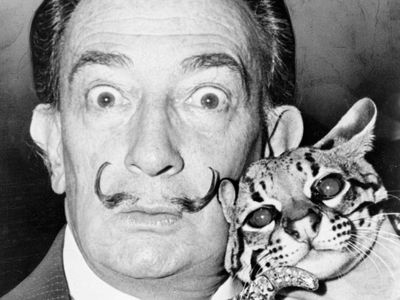
Salvador Dalí is widely regarded as a 20th-century Renaissance artist because of the extraordinary range of media he mastered and his conscious embrace of the universal genius ideal embodied by Leonardo da Vinci. Born in Figueres, Spain, in 1904, Dalí was formally educated in fine arts in Madrid and fell under the influence of Impressionists and Renaissance masters from a young age. While he became the most popular and influential painter associated with Surrealism, his career extended far beyond easel painting. From the late 1930s until his death in 1989, Dalí experimented across an astonishing spectrum of creative fields, including designing fabrics, perfume bottles, and jewellery, staging photographs with himself as the leading character, appearing as a performance artist on television, writing opera librettos, creating posters, ads and magazine covers, collaborating with Elsa Schiaparelli, Walt Disney and Alfred Hitchcock, and illustrating and writing books.
This predilection for expressing himself in multiple disciplines evokes the Renaissance idea of the universal genius, and Dalí cited Leonardo da Vinci as a vital source of inspiration. His artistic repertoire included painting, graphic arts, film, sculpture, design, and photography, and he was not restrained to the visual arts, producing fiction, poetry, essays and criticism. Like the Renaissance polymaths he admired, Dalí fused technical mastery with conceptual ambition. His painterly skills are often attributed to the influence of Renaissance masters, and he later developed his “nuclear mysticism” style based on his interest in classicism, mysticism, and scientific developments. Exhibitions such as “Salvador Dalí. Surrealist and Classicist” at the Fabergé Museum have emphasized Dalí’s conceptualizations of the legacy of Italian Renaissance figures like Michelangelo and Cellini, revealing the kinship between modernism and classicism in his work.
Dalí’s Renaissance spirit also manifested in his desire to shock, disturb and surprise, transgressing notions of good and bad taste through his “paranoiac-critical” method. He believed objects, people and events have no unequivocal meanings, and time and space could merge and undergo metamorphoses. Beyond his iconic moustache and _The Persistence of Memory_, Dalí’s public persona became inseparable from his art. He used the emerging television and popular press of the 1940s onward to present his views on life and art, becoming one of the first artists to fully harness mass media. As one auction house notes, few people have such a peculiar universe as Dalí, where an imaginative mix of madness performed with technical perfection reigns. An artist, designer, writer, filmmaker, and provocateur, he remains an iconic Renaissance man of the 20th century whose scope broadened from Renaissance-influenced foundations to become a leader of Surrealism and a cultural icon.