
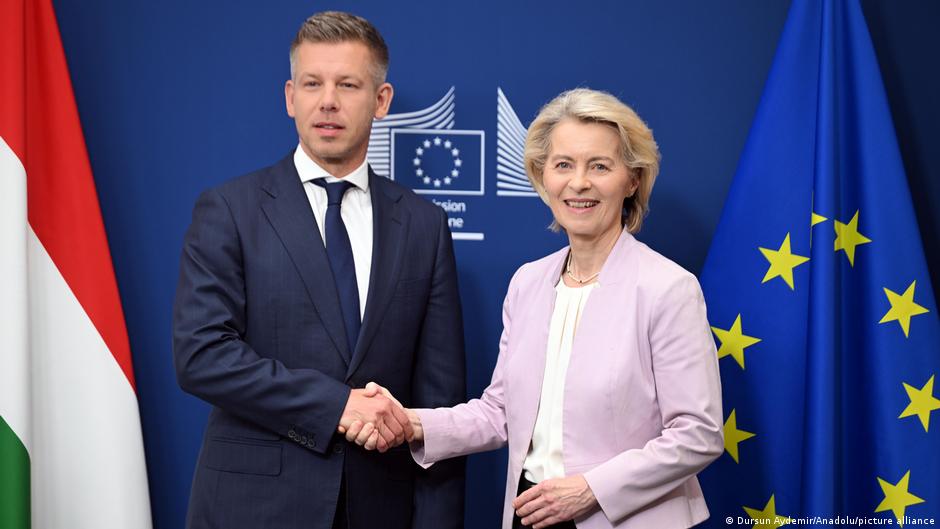
The European Union has agreed to release 16.4 billion euros, about $19 billion, in previously frozen funds for Hungary after new Prime Minister Peter Magyar enacted rapid reforms aimed at reversing democratic backsliding under his predecessor Viktor Orban. European Commission President Ursula von der Leyen announced the agreement Friday, May 29, 2026, following weeks of negotiations in Brussels, calling it a signal of the EU’s embrace of Budapest’s new government. The package includes 10 billion euros from the EU Recovery Fund in grants and cheap loans, plus 4.2 billion euros in cohesion funds that had been suspended due to rule-of-law concerns. A further 2.2 billion euros in cohesion funds will become available as the government completes additional steps.
Von der Leyen said Hungary’s progress on “super milestones” and other conditionalities allowed the Commission to unlock the funding, noting that “a great deal of work has already been achieved in very short time” since Magyar’s government took office. She added that “we can already feel a strong wind of change across Hungary” and that “investors confidence is returning. Trust is being rebuilt”. Magyar called the deal a “historic breakthrough” for Hungary and said his government was “very grateful, and we are ready to continuing cooperating together in the interest of the Hungarian people and all the European citizens”.
The funds are considered crucial for Hungary’s slumping economy, which barely exited recession in the first quarter of 2026 after years of stagnation and faces a budget deficit that could reach 6.2% of GDP this year. Magyar inherited the deficit after heavy pre-election spending by Orban and has pledged to use the money to “rebuild Hungary, to jump start the economy, to restore and develop public services, and to strengthen the competitiveness of Hungarian companies and small and medium-sized enterprises”.
Magyar’s Tisza party secured a two-thirds supermajority in the April election, ending Orban’s 16-year tenure and giving the new government the ability to change the constitution and push through laws quickly. EU officials say the supermajority will allow Budapest to make the necessary legal changes to access time-sensitive recovery funds, including 6.5 billion euros in grants and 3.9 billion euros in cheap loans that must be drawn by August 31 or be irrevocably lost. Magyar also said Hungary would soon submit its official request to join the European Public Prosecutor’s Office as part of anti-corruption commitments.
The EU froze around 18 billion euros earmarked for Hungary in 2022 over concerns about corruption, judicial independence, and the treatment of LGBTQ issues under Orban’s rule. A year later, the Commission found sufficient reforms to release about 10.2 billion euros, but the bulk remained blocked. Magyar’s victory and pro-Europe platform have buoyed expectations in Brussels, with one EU lawmaker saying “it’s practically as if Hungary is rejoining the European Union”. Still, some diplomats caution that concrete actions rather than warm words alone will prove genuine change is happening. The agreement comes as Brussels also seeks Hungarian support for files previously blocked by Budapest, such as Ukraine membership talks, though Magyar has reiterated that Hungary will only agree to Ukraine starting talks if there is an agreement on minority rights of ethnic Hungarians.