

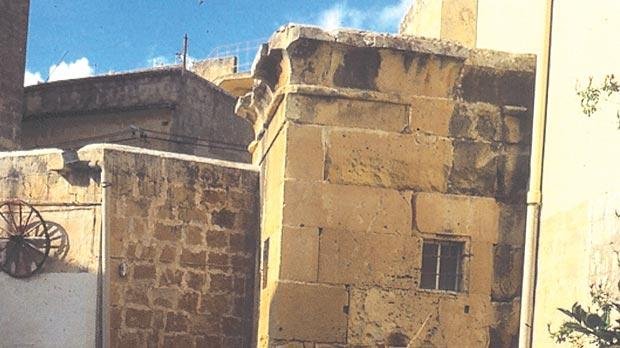
One of Malta’s last surviving Punic towers is to be restored, after an ancient Punic tower in Żurrieq will be restored and the locality’s parish house opened to the public after the Planning Commission gave its go-ahead to the proposal, in a decision that rescues one of the most precious and fragile fragments of Malta’s Phoenician and Punic past from obscurity and from the slow damage of time, neglect and unsympathetic later building. Known as the Domus Curialis, the parish house complex is a Grade II scheduled building on Misraħ ir-Repubblika, built pre-1967, and housing the Punic Tower in its rear garden, a Class A archaeological site, and the restoration and renovation of Domus Curialis, located on Triq San Mikiel and Triq il-Karmnu, and the historic Punic Tower, considered the most outstanding surviving structure attributed to the Phoenician period, had originally faced refusal by the case officer, but now, the conservation of the late 6th-century BC tower in the private backyard of the archpriest’s residence will go ahead, together with the removal of abutting structures and the building of sheltering, in a project that will finally give this hidden treasure the care, protection and visibility it deserves. The quadrangular structure was the only standing Punic-era tower of its height remaining in Malta and Sicily, according to local architectural and heritage documentation, and the remains of an unidentified Punic building exist incorporated into several properties in Żurrieq, Malta, including a well-preserved structure commonly known as the Punic Tower or the Żurrieq Tower, which is found inside the private garden of the Domus Curialis, the house of the town’s archpriest, and which is the most substantial surviving example of Punic architecture on the island, standing some 5.5 metres high and in relatively good condition, unlike the other Punic-Roman towers, because this one has a square shape, and it is believed to have been part of a larger building. The building’s age and purpose are not known, but it might date back to around the late 6th century BC, and the tower’s architecture suggests that it formed part of a prominent building, and it has been speculated that it could have been a temple, possibly that of Melqart which was mentioned by Ptolemy, or it might have also been a country house or a monumental tomb, and the building is not believed to have been a defensive tower, and it has a different typology from other Punic-Roman towers whose remains have been found in Malta, which are generally round, built on high ground, and believed to have been built while the island was part of the Punic or Roman Empires, to defend a hamlet or town, to communicate with signals from one to another, and to have remained in use throughout the Roman period, until at least the 3rd century AD, while the Żurrieq tower stands apart as something more monumental, more domestic or more sacred, a mystery that makes its survival even more valuable. Further excavations were carried out in 1938 and in 1964, by R. V. Galea and Charles Zammit, in an attempt to date the tower, and they revealed the building’s foundations and found pottery ranging from the Punic to the modern periods, which matched the building’s attribution to the Phoenician and Punic period but did not conclusively prove it, and the remains of the building, especially the well-preserved tower, are regarded as the most outstanding surviving structure of the Punic period within the Maltese Islands, so that the Planning Authority scheduled the remains as a Class A archaeological site on 17 April 1998, while the Domus Curialis and the adjacent buildings into which the Punic structure has been incorporated were scheduled as Grade 2 properties, and the tower is not normally open to the public and it can only be accessed by appointment, a seclusion that has protected it but also hidden it from the very people whose heritage it is. Now, under application PA/06612/24, the project also proposes the installation of a lift and circulation bridges, the conservation of church remains and the sanctioning of changes from previously approved plans, so that the parish house can be opened to the public, visitors can move safely around the site, the tower can be seen without being damaged by close contact or by the weight of later structures leaning against it, and the whole complex can be understood as a living palimpsest, from Punic stones to a parish house to a modern community space, and Domus Curialis lies within the urban conservation area of Żurrieq and is in close proximity to the parish church dedicated to St Catherine, Virgin and Martyr, also scheduled as a Grade I monument, placing the tower at the very heart of Żurrieq’s historic core. The restoration is therefore not just about repairing old stones, it is about giving Malta back a direct link to the Phoenicians and Carthaginians who sailed these seas more than two and a half thousand years ago, it is about recognising that among the six Punic-Roman towers identified on the main island, and among the other towers whose remains were demolished to make way for the runway of Malta International Airport, this quiet tower in a priest’s garden has survived when so many others did not, and it is about ensuring that future generations in Żurrieq and across Malta will no longer have to ask permission to glimpse their oldest history, but will be able to walk into the Domus Curialis, look up at the tower that has stood there since before Rome rose to power, and understand that Malta’s story did not begin with the Knights, or the British, or even the Romans, but with the Punic sailors, traders and builders who left this tower standing as their most eloquent and enduring monument.
One Of Malta’s Last Surviving Punic Towers To Be Restored
Share on
Related posts

Third Of Maltese Fear Budget 2027 Will Leave Country Worse Off, Survey Finds
Around a third of respondents to a recent survey believe Budget 2027 will…

Libya Guarantees Lilu King Won’t Be Executed If Extradited
Libya guarantees Lilu King won’t be executed if extradited, after Libya formally guaranteed…
Momentum Calls On Attorney General To Resign
Momentum calls on Attorney General to resign, after Momentum urged Attorney General Victoria…

Comino’s Famous Roofless Cave Collapses
Comino’s famous roofless cave collapses, after a large section of Popeye Cave at…

30 Choirs To Take Part In Malta International Christmas Choir
30 choirs to take part in Malta International Christmas Choir Festival, as local…
PN: Caruana Must Publish Population Report Immediately
PN: Caruana must publish population report immediately, after the Partit Nazzjonalista has called…






Search
About us

MALTA BULLETIN
Discover Latest News, Hot Topics, Politics and Entertainment News With Malta Bulletin