

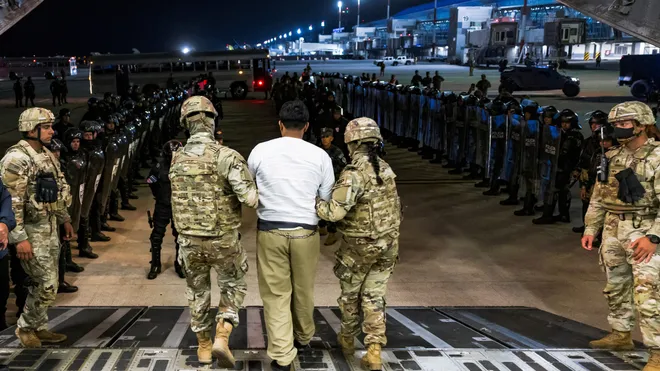
The United States has begun pressuring African governments to accept migrants who have no ties to the continent, combining financial incentives with threats of visa restrictions as part of a broader push to expand deportations under the Trump administration. It started with warnings of US visa bans targeting a wide range of African countries, and was followed by agreements to “scatter” deportees from around the world to nations across Africa, often accompanied by multimillion-dollar cash offers to their governments. Two former State Department officials told AFP that Washington is using visa bans and other restrictions to strongarm countries into taking third-country nationals as part of a crackdown on immigration.
Under the policy, people from Asia, Latin America and elsewhere have been flown to countries including Eswatini, Rwanda, South Sudan, Uganda, the Democratic Republic of Congo, Ghana and Cameroon. In Eswatini, 29 deportees had arrived by July 2026 under a $5.1 million agreement to build border and migration management capacity, with most held in the maximum-security Matsapha prison. Rwanda reportedly agreed to take up to 250 deportees in exchange for roughly $7.5 million in US support, while Cameroon received nine migrants under a deal the New York Times said involved $30 million. Overall, Senate Foreign Relations Committee data cited in reports put US spending at more than $35 million to deport roughly 300 people to remote countries and African nations, averaging about $116,666 per person.
Lawyers and rights groups describe the practice as creating a “legal black hole,” with deportees detained without charge in countries where they have no connections and few rights. Human Rights Watch called the opaque deals a violation of international human rights law, arguing they are designed to “instrumentalize human suffering as a deterrent to migration”. The organization urged African governments to reject the agreements and terminate those already in effect. The State Department said implementing the administration’s immigration policies is a top priority and that it remains committed to ending illegal and mass immigration, while two-thirds of the 39 countries hit by full or partial US travel bans are in Africa, as are nearly half of the nations that have struck deportation deals with Washington.