
The 2026 Venice Art Biennale opened under a cloud of geopolitical fracture, where the usual curatorial conversations about aesthetics were overtaken by protests, resignations, and disputes over legitimacy itself. Often described as the “Olympics of the art world,” the Biennale this year became defined less by individual artworks than by the tensions surrounding them. Opening week was marked by demonstrations, political disputes, and jury resignations tied to objections over evaluating certain national pavilions. The return of the Russian Pavilion after years of absence, controversies surrounding the Israeli Pavilion, and debates about participation by states whose leaders face International Criminal Court charges transformed Venice into something larger than an art exhibition. For decades, the art world has debated how political art should be and how much space should remain for aesthetics alone. Venice 2026 suggested that distinction may no longer hold, as art is no longer observing political and cultural conflict from a distance but becoming one of the arenas in which those conflicts unfold in real time.
The most visible flashpoints centered on national representation. Russia returned to the Giardini for the first time since its full-scale invasion of Ukraine in February 2022, staging _The Tree is Rooted in the Sky_, an exhibition of more than 50 young musicians, poets, and philosophers. The decision drew sharp backlash: Ukraine’s foreign and culture ministers said the Biennale “must not become a stage for whitewashing the war crimes that Russia commits daily,” while the European Commission threatened to withhold €2 million in funding. The Russian pavilion ultimately remained closed to the general public and accessible only to journalists and authorised personnel during professional preview days. Meanwhile, nearly 200 artists and curators participating in the 2026 Biennale signed an open letter calling for the exclusion of the Israeli Pavilion until Israel is “brought to justice for its crimes,” citing the continuing absence of a Palestinian pavilion as evidence of inequality. Posters and signs in support of Palestine were displayed on the door of the Belgian pavilion, which closed to the public due to a pro-Palestine strike prior to opening.
The institutional strain reached the awards process itself. Days before the opening, the entire five-member international jury, led by Brazilian curator Solange Farkas, resigned after announcing it would refuse to award prizes to artists from countries whose leaders face ICC charges — a not-so-subtle reference to Russia and Israel. Biennale organisers postponed the Golden Lion awards and replaced them with public voting by visitors. The Biennale Foundation’s president, Pietrangelo Buttafuoco, defended the inclusion of contested states by rejecting “any form of exclusion or censorship of culture and art,” though Italy’s culture ministry said the move to readmit Russia was made “entirely independently by the Biennale Foundation, despite the Italian government’s opposition”.
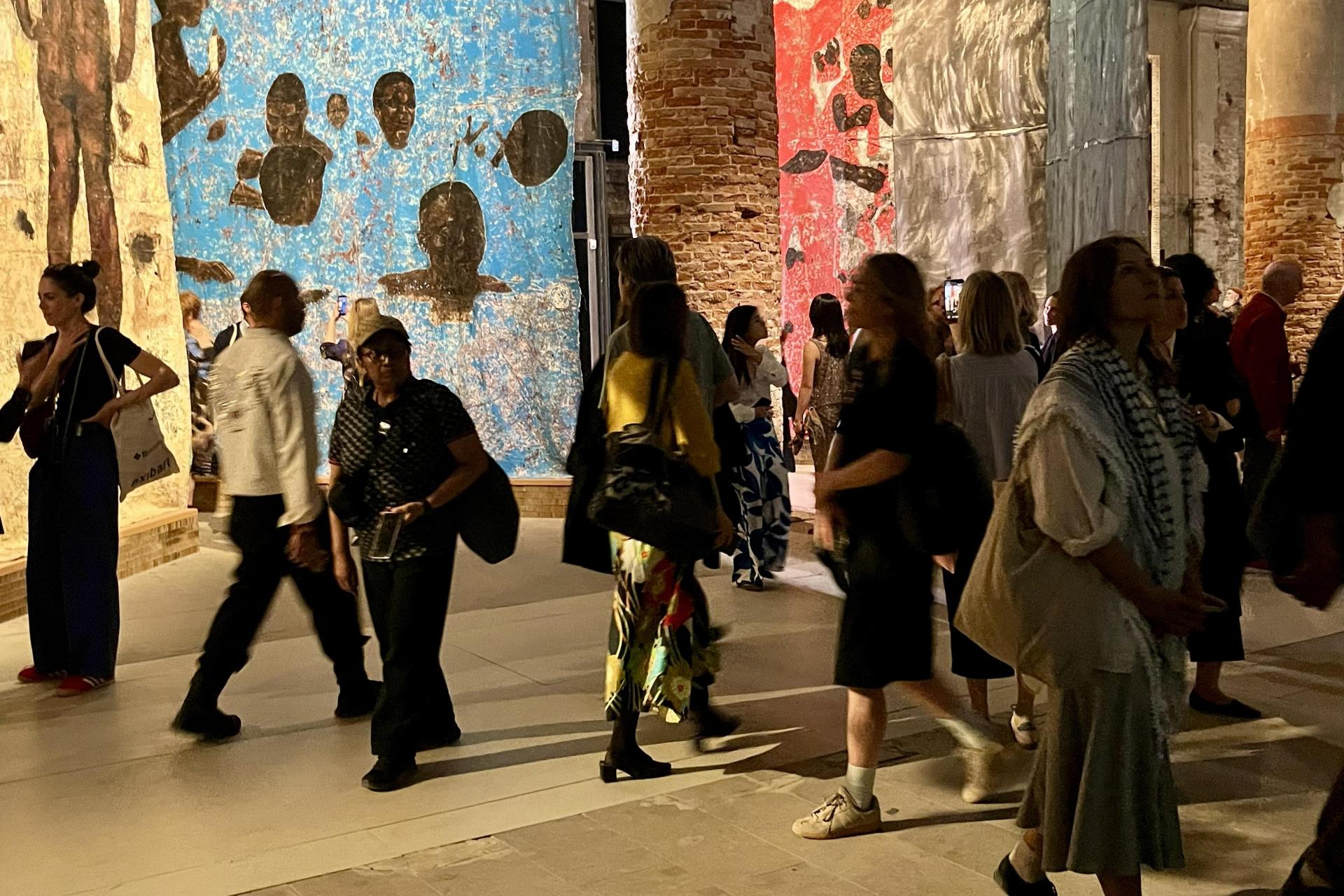
Amid the conflict, the theme of camaraderie and coexistence persisted in individual pavilions. Switzerland’s contribution, _The Unfinished Business of Living Together_, challenged the country’s image as a haven of consensus and asked how coexistence is actually organized — what is accepted and what is left on the margins. The curatorial theme for the main exhibition, _In Minor Keys_, was conceived by the late Swiss-Cameroonian curator Koyo Kouoh, the first Black woman to lead the Venice Art Biennale. Though Kouoh died suddenly in May 2025, the Biennale board decided to realise her exhibition as she conceived it, seeking to preserve a vision that emphasized intimacy, affect, and reflection in a world defined by noise and spectacle. As Buttafuoco noted, “Her proposal is a whisper, a minor key, a sotto voce, the method through which light can find the right space and expand.”
The contradictions of earlier editions — conversations about collapse unfolding alongside collector dinners and private yacht events — felt different this year. Reality entered the room. The most powerful pavilion at Venice may not have belonged to any country at all. It may have been reality itself. Yet the Biennale’s promise remained: to create conditions for dialogue by bringing people into contact with one another’s stories, leaving open the possibility for greater understanding, even when countries arrive carrying conflicts that cannot be settled in an exhibition hall. The 61st International Art Exhibition runs until November 22.